
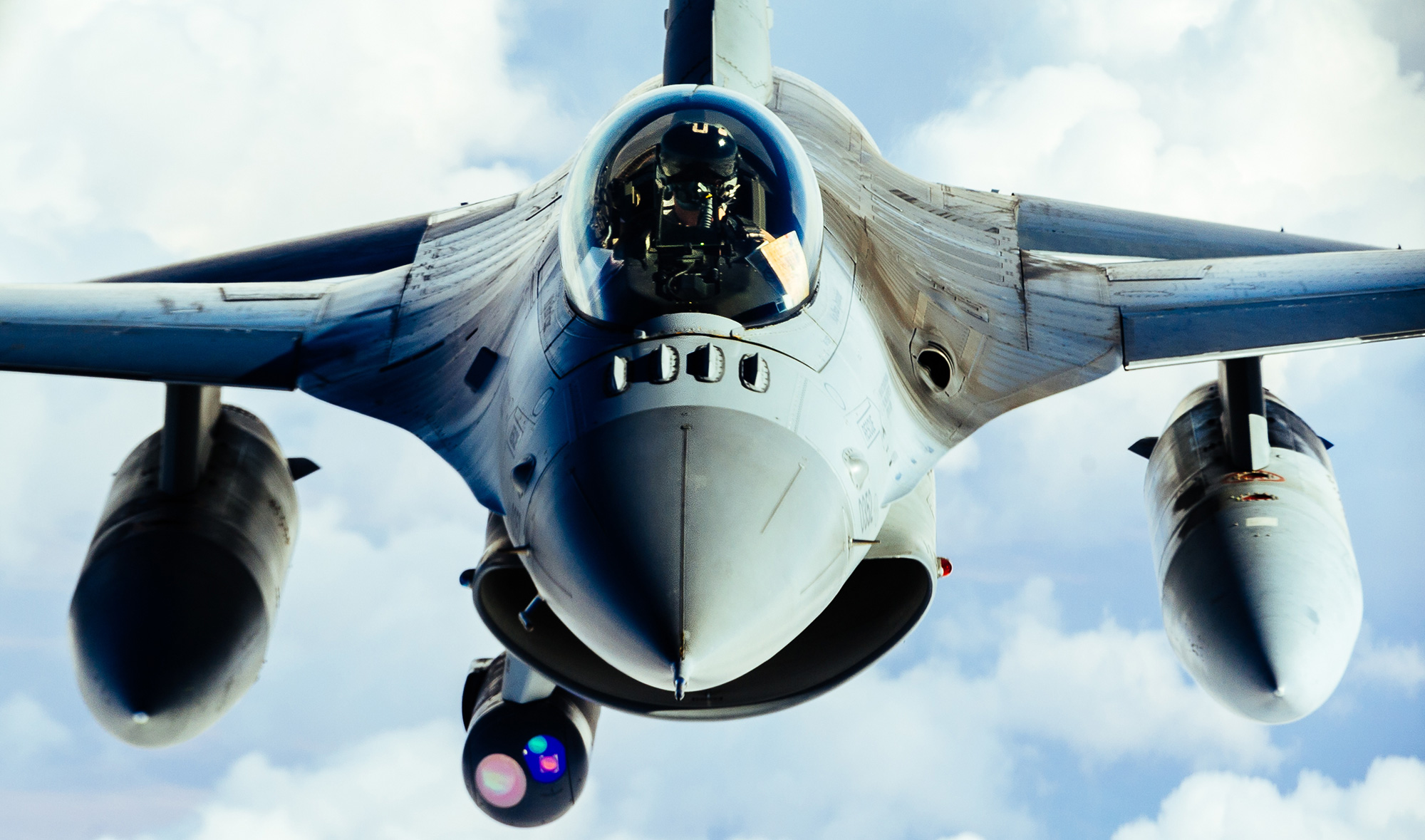


The US State Department approved the $1.673 billion sale to Bulgaria of eight F-16 fighter jets and associated equipment, weapons and training
The U.S. State Department has approved the sale to Bulgaria of eight F-16 Viper fighter jets and associated equipment, weapons and training for an estimated $1.673 billion, the Defense Security Cooperation Agency said in a release.
"The proposed sale will contribute to Bulgaria's capability to provide for the defense of its airspace, regional security, and interoperability with the United States and NATO," the Monday, June 3 release said.
"Bulgaria currently relies on the United States and the United Kingdom to participate in joint air policing. By acquiring these F-16s and the associated sustainment and training package, Bulgaria will be able to provide for the defense of its own airspace and borders," DSCA said.
Lockheed Corporation is the prime contractor for the sale which includes a wide range of equipment and services.
Last June, Bulgaria's parliament approved spending 1.8 billion leva ($1.1 billion) on new aircraft to replace its current fleet of Soviet-built MiG-29 jets.
That came after the government of conservative Prime Minister Boyko Borissov had sidetracked an earlier defense ministry commission review that had shortlisted Sweden’s Gripen fighter as a preferred option.
Requests for proposals were then sought for new or used F-16s, new or used Eurofighter Typhoons, second-hand Rafale fighters and new or used Gripens from Sweden. The re-run process proved controversial, not least because of the difference in price to that spending approved, but it led to the cabinet recommending the purchase of F-16s on January 9, and parliamentary approval to begin negotiations was given on January 16.
F-16 Vipers for Bulgaria
According to the DSCA, the government of Bulgaria requested to buy eight F-16 C/D Block 70/72 aircraft, better known as the F-16 Viper, and a wide range of associated equipment, weapons, training and support.
Included are nine Northrop Grumman AN/APG-83 Active Electronically Scanned Array (AESA) radars, which uses technology derived from F-22 and F-35 radars, and four AN/AAQ-33 SNIPER Targeting Pods.
Weapons include 16 AIM-120 C7 Advanced Medium Range Air-to-Air Missiles (AMRAAMs); 24 AIM-9X Sidewinder missiles; nine M61 Vulcan 20mm cannons; 15 GBU-49 Enhanced Paveway II guided bomb kits; 15 GBU-54 Laser JDAM guided bomb kits; 28 GBU-39 Small Diameter Bombs (SDB-1); and 24 MK-82 Bombs (Tritonal).
Defensive systems include nine AN/ALQ-211 Internal Advanced Integrated Defensive Electronic Warfare Suites, countermeasure dispensers and 4,140 Infrared Flare countermeasures.
Other systems and services include a flight and maintenance simulator, communications equipment, facilities and construction support, spares parts, training and U.S. Government and contractor technical, engineering and logistical support services.
International interest in the F-16 Fighting Falcon, a combat-proven fourth generation fighter aircraft that first flew in 1974 remains high.
The F-16 Block 70/72 is the newest and most advanced F-16 configuration to date, with a structural life more than 50 percent beyond that of previous F-16 aircraft, according to Lockheed Martin. It features an active radar with new avionics and software that takes advantage of new technologies.
The F-16 Viper variant includes an active electronically scanned array radar, a new mission computer and electronic warfare suite, automated ground collision avoidance system, and various cockpit improvements. It first flew in October 2015.
In April 2018, Greece announced it would upgrade 85 of its fleet of F-16 aircraft to the Viper configuration, and the U.S. State Department approved the sale to Slovakia of 14 F-16 Vipers.
