


Learn how the E-4 Nightwatch commands and safeguards US nuclear forces in the air, ensuring continuity of government in crises.
The E-4 Nightwatch, often dubbed the “Doomsday Plane,” is a highly specialized airborne command post operated by the US Air Force.
Designed to ensure the continuity of government and military command in the event of a nuclear attack or catastrophic disruption to ground-based facilities, the E-4 remains one of the most strategically critical yet secretive aircraft in the US arsenal.
This guide explains how the E-4 Nightwatch functions as the last line of airborne command and control in a nuclear-contested world.
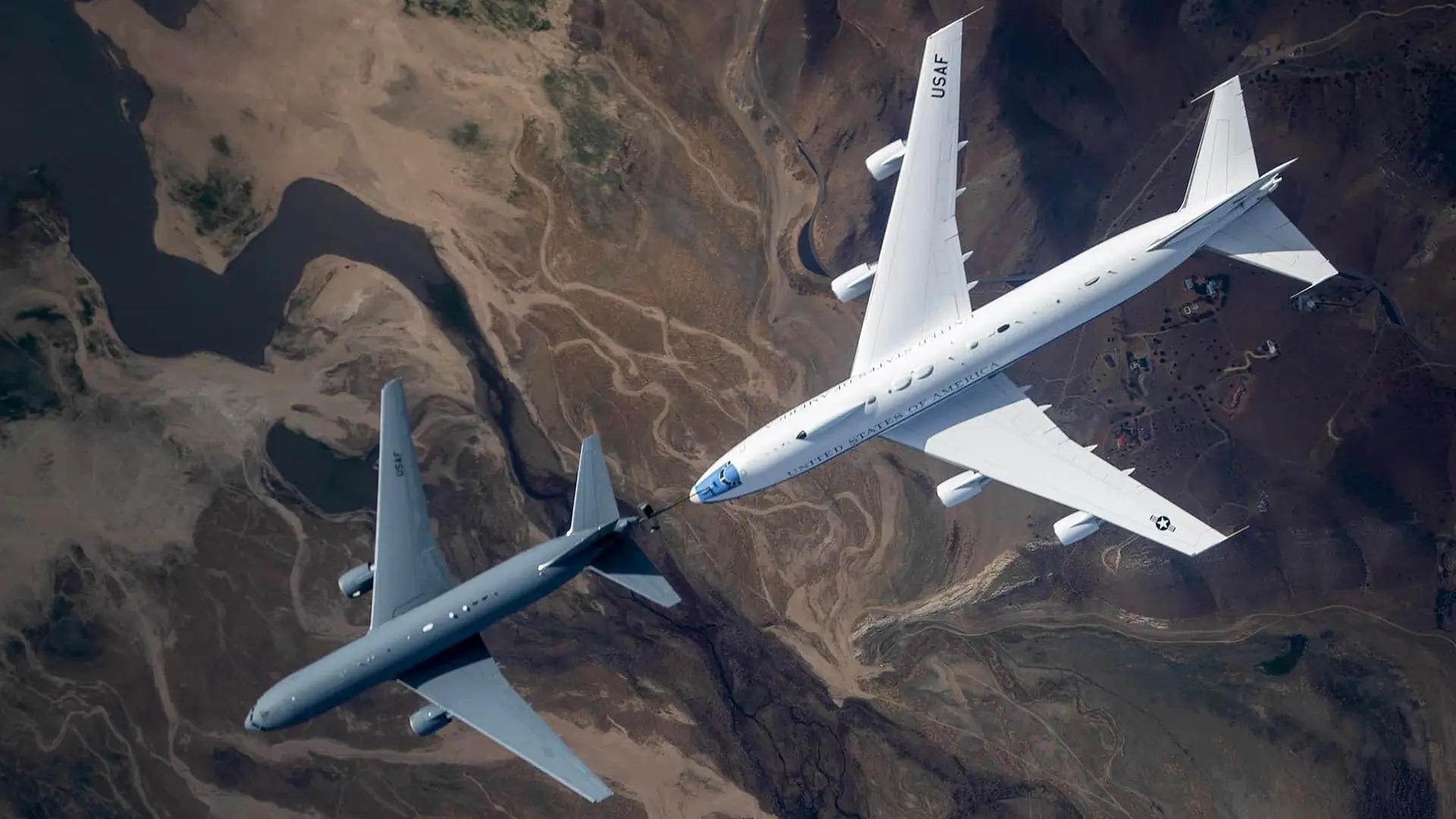
 Flying high above conflict zones, the E-4 Nightwatch keeps US leadership connected in extreme scenarios. Photo: Airman 1st Class David S. Calcote/US Air Force
Origins and Design Philosophy
The E-4 program emerged during the Cold War, in response to the growing threat of nuclear conflict and the need for a hardened, survivable command center.
The US recognized that relying solely on land-based command infrastructure left the nation vulnerable to a decapitating strike.
The solution was an airborne platform capable of maintaining command and control continuity, even under nuclear attack. Boeing’s 747-200 airframe was chosen for its size, reliability, and range, providing a stable foundation for extensive modifications.
The design philosophy prioritized survivability, redundancy, and operational continuity over speed or stealth.
The aircraft is equipped with redundant systems, hardened electronics, and specialized shielding to withstand electromagnetic pulses (EMP) and other nuclear-related threats.
The E-4 can serve as a command hub for nuclear and conventional forces, linking air, land, and sea units while remaining airborne for extended periods.
 Equipped with advanced communications, the E-4 Nightwatch coordinates military operations across air, land, and sea. Photo: Justin Oakes/US Air Force
E-4’s Operational Profile
Equipped with advanced communications, hardened electronics, and global reach, the E-4 Nightwatch is built to command and coordinate US forces even under extreme conditions.
Key features include:
- Advanced communications suite: The E-4 can communicate with intercontinental ballistic missiles, submarine-launched ballistic missiles, strategic bombers, naval units, and field commanders worldwide, maintaining command over US nuclear and conventional forces.
- EMP-hardened systems: The electronics and wiring are shielded against electromagnetic interference from nuclear detonations, ensuring operational reliability in extreme conditions.
- Extended endurance: Coupled with in-flight refueling, the E-4 can remain aloft for several days, providing continuous command presence.
- Integrated mission systems: The aircraft features conference rooms, command stations, and secure data links, allowing senior leadership to direct operations, coordinate with allies, and maintain situational awareness.
- Mobility and survivability: Unlike fixed command centers, the E-4’s mobility makes it difficult for adversaries to target or neutralize.
E-4 Variants
The primary variant of the aircraft is the E-4B, which includes extensive avionics, communications gear, and defensive systems.
While sometimes referred to as the E-4C in older sources, the modern operational fleet is standardized around the E-4B, maintained by the Air Mobility Command at Offutt Air Force Base in Nebraska.
Over the decades, the aircraft has undergone numerous upgrades to radar, communications, and computing systems, ensuring relevance despite its 1970s airframe origins.
Global Impact and Future Outlook
As the central node of the US nuclear command and control system, the E-4 Nightwatch’s existence reinforces deterrence, signaling to potential adversaries that the United States can maintain control of its forces even in worst-case scenarios.
Its presence also supports NATO and allied operations by providing a reliable airborne coordination platform and ensuring interoperability and operational continuity during multinational crises.
Despite the airframe’s age, the E-4 remains indispensable. Ongoing modernization programs have updated communications, avionics, and defensive systems, ensuring the aircraft can operate in modern electronic warfare and contested environments.
The fleet is expected to remain operational into the 2030s and beyond, though the US Air Force is exploring next-generation airborne command solutions to eventually replace it.
