


No aircraft dominates the electromagnetic spectrum like the Growler. This guide explains how it jams radars, disrupts communications, and enables air superiority on the modern battlefield.
Before a strike package reaches its target, someone has to blind radars, disrupt communications, and confuse enemy air defenses.
That “someone” is increasingly the Boeing EA-18G Growler, a carrier-based electronic attack aircraft built to jam, deceive, and suppress hostile emitters while still flying with frontline fighters.
Here’s how it came to be, what makes it work, where it has flown, and why its mission is only growing more important.
At a Glance
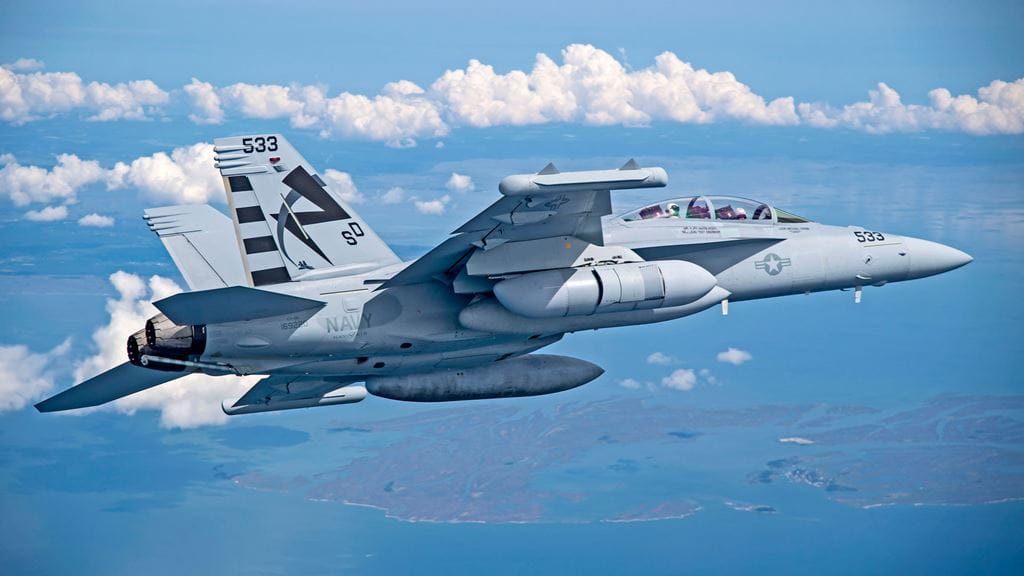 Derived from the F/A-18F Super Hornet, the EA-18G Growler replaces the fighter's cannon with advanced electronic warfare systems for radar jamming and electronic attack. Photo: Raytheon
What Is the EA-18G Growler?
The Growler is a carrier-capable electronic attack aircraft developed from the F/A-18F Super Hornet airframe.
Instead of focusing primarily on air-to-air combat, it targets the enemy’s electromagnetic systems: radars, communications links, and air defense networks.
It can escort strike aircraft, jam hostile emitters, geolocate radar sources, and launch anti-radiation missiles against air defense sites.
How It Came to Be
The US Navy began exploring a replacement for the EA-6B Prowler in the early 2000s. Rather than designing an entirely new aircraft, engineers adapted the proven Super Hornet platform for electronic attack missions.
The result kept the Super Hornet’s carrier compatibility, engines, and much of its logistics footprint while adding dedicated electronic attack equipment and mission systems.
Boeing served as the prime contractor and system integrator, while Northrop Grumman provided major electronic warfare systems and airframe sections. This approach reduced development risk and accelerated fielding compared with a clean-sheet design.
Key milestones:
- 2001: Initial EA-18 airborne electronic attack concept demonstrated
- 2003: US Navy awards development contract to Boeing
- 2004: Boeing begins manufacturing the first EA-18G test aircraft in October
- 2006: First EA-18G prototype flies in August
- 2008: Introduced into the US Navy fleet training in June
- 2009: Initial operational capability achieved
- 2025: Approved $2 billion sustainment package for Australia’s Growler aircraft
How the Growler Works
Electronic Attack Suite
The Growler carries pods and internal systems that can detect, classify, and jam hostile radar emissions. By overwhelming or deceiving enemy sensors, it helps protect friendly aircraft during combat operations.
Radar Suppression
In addition to jamming, the aircraft can carry anti-radiation missiles that target enemy radar sites. This allows it to perform SEAD and DEAD missions.
Networked Operations
Because it shares the Super Hornet's avionics architecture, the Growler can operate alongside fighters, airborne warning aircraft, and naval forces as part of a larger combat network.
Next-Generation Jammer
The Growler's current jamming capability relies on the AN/ALQ-99 Tactical Jamming System, a pod-based electronic attack system whose core technology dates to the 1970s. While the ALQ-99 has been continuously updated, its age increasingly limits performance against modern adaptive radar systems that can rapidly change frequency to avoid jamming.
Its replacement is the Next-Generation Jammer (NGJ), developed by Raytheon.
The NGJ-Mid Band is the first increment, targeting the radar frequencies most commonly used by modern air defense systems. It uses active electronically scanned array technology to generate more powerful, more precise, and more flexible jamming effects than the ALQ-99 can achieve.
The US Navy began fielding NGJ-Mid Band in 2024, and Australia received the system in 2026 as part of its Growler modernization.
When fully integrated, the NGJ will significantly expand the Growler's ability to counter the kinds of networked, frequency-agile air defense systems increasingly fielded by China and Russia.
Strengths
- Spectrum dominance: It can jam multiple threat radars and communications systems simultaneously.
- Carrier compatibility: Unlike many specialized EW aircraft, it operates from aircraft carriers alongside strike fighters.
- Networked operations: It shares targeting and threat data with other aircraft and command systems, supporting broader SEAD campaigns.
Limitations
- Not a stealth aircraft: It relies on jamming, tactics, and escort operations rather than low observability.
- Pod dependence: Much of its capability sits in external pods, which add drag and require continual modernization.
- Finite magazine: Anti-radiation missiles and jamming resources are limited by payload and mission duration.
 Built for Suppression of Enemy Air Defenses, the EA-18G Growler can locate, jam, and help neutralize hostile radar systems, clearing the way for friendly aircraft. Photo: Honeywell
Global Use
The US Navy uses the Growler for carrier air wing electronic attack, escort jamming, and suppression of enemy air defenses.
Growlers have supported operations and exercises ranging from Middle East combat deployments to large multinational exercises such as Red Flag, where electronic warfare integration is a major focus.
Australia is the only nation outside the United States to operate the EA-18G Growler, making the Royal Australian Air Force (RAAF) one of Washington's closest electronic warfare partners.
The RAAF operates 12 EA-18G Growlers alongside 24 F/A-18F Super Hornets, with the Australian government committed to extending the fleet's service life into the late 2030s and beyond.
Australia's involvement goes beyond simply operating the aircraft — Canberra contributed 250 million Australian dollars toward development of the Next Generation Jammer, giving it a stake in the system that will define the Growler's capabilities for the next decade.
Most recently, the US State Department approved a $2-billion foreign military sale to Australia in June 2025 covering sustainment support, including Next Generation Electronic Attack Units, advanced electronic warfare systems, and communications equipment.
A further $250-million training package was approved in June 2026, underscoring that Canberra's focus is not on expanding aircraft numbers but on keeping its existing Growler fleet at peak operational readiness for coalition operations across the Indo-Pacific.
Future Outlook
The Growler’s future is tied to Next-Generation Jammer upgrades and tighter integration with stealth aircraft such as the F-35 Lightning II.
As air defenses become more networked and adaptive, electronic attack aircraft will need greater power, more advanced software-defined jamming, and faster data sharing.
The Growler is expected to remain the US Navy’s primary airborne electronic attack platform into the 2030s, evolving through pod upgrades rather than wholesale replacement.
