



This guide explores the P-3 Orion's history, mission set, and enduring influence on modern maritime patrol operations before the era of drones and networked sensors.
Long before drones and networked sensors became staples of maritime surveillance, one aircraft defined how navies hunted submarines across vast oceans.
The P-3 Orion combined endurance, sensors, and weapons into a single platform that became synonymous with undersea warfare for decades.
Though many operators are now transitioning to newer systems, the Orion’s legacy remains deeply embedded in modern maritime operations.
This guide explains what the Orion was built to do, how it evolved, and why its impact will remain despite the emergence of successors.
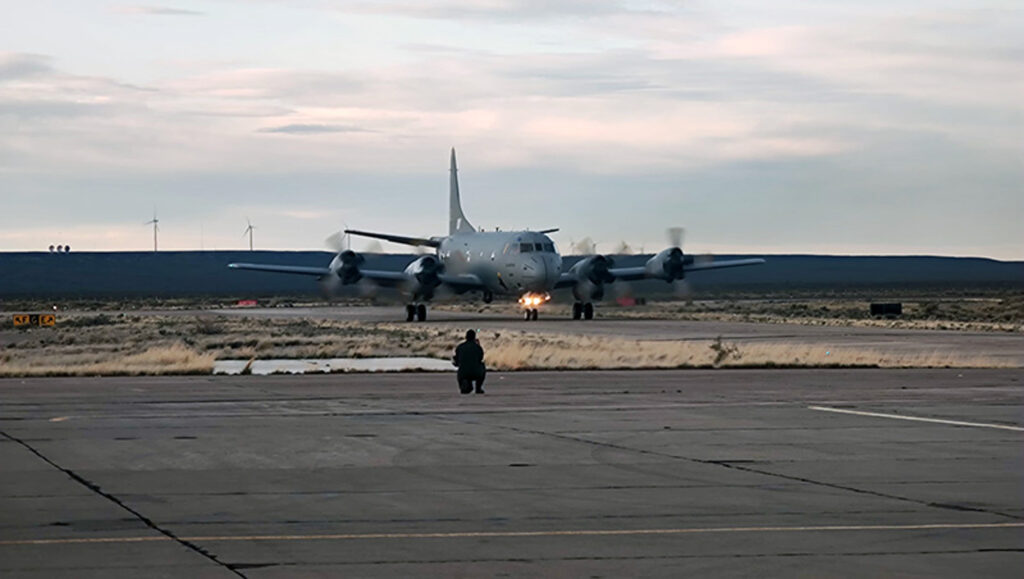 Argentina's first P-3C Orion maritime patrol aircraft. Photo: Argentine Navy
Inside the P‑3 Orion
The P-3 Orion is a long-range maritime patrol and anti-submarine warfare (ASW) aircraft developed by Lockheed Martin in the late 1950s and early 1960s.
It emerged at the height of the Cold War and was created to detect, track, and destroy increasingly quiet Soviet submarines before they could threaten carrier strike groups or strategic sea lanes.
Based on the civilian L-188 Electra turboprop airliner, the jet was purpose-built for naval missions requiring long endurance, low-altitude flight, and extensive onboard sensor integration.
Its design emphasized range and persistence rather than speed, allowing it to patrol thousands of miles of ocean and loiter over contact areas for hours — something few aircraft could do at the time.
What the P-3 Orion Does
At its core, the P-3 Orion is a multi-mission maritime aircraft, optimized for ASW but also capable of surface surveillance, intelligence collection, and maritime strike missions.
Key Specifications and Features
- Crew: Typically 11 (aircrew and mission operators)
- Range: Over 4,400 nautical miles (8,150 kilometers/5,060 miles per hour)
- Endurance: Up to 12+ hours on station
- Propulsion: Four Allison T56 turboprop engines
- Maximum Speed: ~405 knots (750 kilometers/466 miles per hour)
The Orion’s most distinctive feature is its sensor suite. Over its long service life, the aircraft has been equipped with surface-search radar, magnetic anomaly detectors (MAD) for submarine detection, electro-optical sensors, and extensive electronic intelligence systems.
It also carries and deploys sonobuoys, enabling it to listen for and track submerged submarines across wide areas.
 The P-3 Orion could remain on station for more than 10 hours, carrying torpedoes, sonobuoys, and sensors to track submarines across vast ocean areas. Photo: Petty Officer 2nd Class Jacquelin Frost/Naval Air Station
The P3-Orion Variants
Rather than producing entirely new airframes, the Orion program evolved through incremental variant upgrades, allowing operators to keep pace with quieter submarines and more complex maritime threats.
The following table breaks down the primary roles, key features, and platform adaptations across the P-3’s operational variants:
Why the US Navy Is Retiring the P-3
The US Navy’s decision to retire the P-3 Orion reflects both success and age. Designed in the 1950s, the aircraft has endured decades of low-altitude flight, corrosive maritime environments, and intensive operational tempo.
Structural fatigue, rising maintenance costs, and diminishing returns from upgrades have made continued service increasingly inefficient.
Equally important, the threat environment has changed. Modern ASW now demands higher transit speeds, networked sensor fusion, and integration into joint kill chains, areas where newer platforms, such as Boeing’s P-8 Poseidon, offer clear advantages.
 Introduced in the 1960s, the P-3 Orion served for decades as the US Navy's primary anti-submarine warfare aircraft. Photo: Petty Officer 2nd Class Jacquelin Frost/Naval Air Station
Operational Role and Global Impact
For decades, the P-3 Orion was the backbone of the US Navy maritime patrol aviation and a cornerstone capability for allied navies worldwide.
It tracked ballistic missile submarines during the Cold War, enforced sanctions, supported counter-piracy missions, and conducted wide-area surveillance across every ocean.
The Orion shaped modern ASW doctrine, standardized sonobuoy-based operations, and proved that persistence and sensors could be as decisive as weapons.
Even as the US Navy retires the type, several international operators continue to fly upgraded Orions, ensuring the platform remains relevant in secondary and regional roles.
