



How do you defend a moving convoy against cheap, fast drones? This guide looks at how the Skyranger 30 combines guns, missiles, and sensors to find out.
Most air defense systems come with a catch: buy the weapon, buy the vehicle it rides on. Dedicated platforms mean dedicated procurement budgets, dedicated training pipelines, and dedicated maintenance fleets — costs that have kept short-range air defense out of reach for many armies trying to rebuild ground-based coverage after decades of underinvestment.
The Skyranger 30 was designed around a different logic. Rather than fielding a new vehicle, Rheinmetall built a modular turret that mounts onto armored platforms the customer already operates.
The result is one of Europe's fastest-growing SHORAD systems, combining a 1,250-round-per-minute 30mm cannon, programmable airburst ammunition, and optional surface-to-air missiles into a turret that can be on the move with mechanized forces within minutes of a threat appearing.
This guide examines the Skyranger 30's design, capabilities, operators, and the role it is expected to play in future layered air defense networks.
At a Glance
What Is the Skyranger 30?
The Skyranger 30 is the latest member of Rheinmetall's Skyranger family of modular SHORAD systems, which traces its origins to the company's Oerlikon air defense portfolio.
Designed to protect maneuvering forces from low-altitude aerial threats, including drones, helicopters, cruise missiles, and low-flying aircraft, the turret can be integrated onto a variety of tracked and wheeled armored vehicles rather than operating as a standalone platform.
At the heart of the system is a stabilized 30mm automatic cannon paired with advanced radar, electro-optical sensors, and optional surface-to-air missiles. This layered approach allows the Skyranger 30 to engage different threats using the most appropriate weapon, improving both effectiveness and cost efficiency.
 Skyranger 30 air defense turret. Photo: Rheinmetall
 How Did the Skyranger 30 Come About?
The Skyranger 30 emerged as armed forces sought replacements for legacy short-range air defense systems following decades of reduced investment in ground-based air defense.
The growing use of small drones, loitering munitions, and precision-guided weapons in conflicts such as those in Ukraine and the Middle East reinforced the need for highly mobile systems capable of protecting troops on the move.
Rather than developing an entirely new vehicle, Rheinmetall designed the Skyranger 30 as a modular turret that could be integrated onto a variety of armored platforms, simplifying adoption for different customers.
Key milestones include:
- 2021: Rheinmetall officially unveiled the Skyranger 30, introducing a new 30mm variant of its Skyranger mobile air defense family designed to counter drones, helicopters, cruise missiles, and low-flying aircraft.
- 2022: The company showcased the Skyranger 30 integrated onto the Boxer armored vehicle at Eurosatory 2022, demonstrating its modular approach for different vehicle platforms.
- 2023: Hungary became the launch customer, selecting the Skyranger 30 turret for its Lynx KF41 infantry fighting vehicles.
- 2024: Rheinmetall received its first production order for the Skyranger 30, with Germany procuring Boxer-mounted systems for the Bundeswehr. During the year, Austria also selected the system for its Pandur EVO fleet, further expanding the program's European customer base.
- 2025: Denmark selected the Skyranger 30 for its future mobile air defense capability, joining a growing list of European operators and customers.
Key Features
30mm Oerlikon Revolver Cannon
The Skyranger 30 is armed with Rheinmetall's 30×173mm Oerlikon KCE-ABM Revolver Cannon, capable of firing up to 1,250 rounds per minute.
It uses programmable Air Burst Munition (ABM) to detonate near a target, creating a cloud of sub-projectiles that significantly increases the probability of destroying small, fast-moving threats such as drones, loitering munitions, and cruise missiles while reducing ammunition expenditure compared with conventional rounds.
The cannon has an effective engagement range of up to 3 kilometers (1.9 miles) and can be paired with short-range surface-to-air missiles for extended coverage.
Remote-Controlled Modular Turret
Unlike traditional air defense vehicles, the Skyranger 30 features an unmanned, remotely operated turret with no turret basket, freeing internal space for the crew and mission equipment while improving vehicle integration.
Its modular architecture allows the turret to be mounted on a wide range of tracked and wheeled armored platforms and configured with different missile types, making it easier for operators to adapt the system to existing vehicle fleets and evolving mission requirements.
Integrated Multi-Sensor Fire Control
The Skyranger 30 combines 360-degree AESA search radar, a stabilized electro-optical sensor package, and optional FIRST (Fast InfraRed Search and Track) and Ku-band tracking radar into a single fire-control system.
Sensor fusion enables the system to autonomously detect, classify, track, and engage multiple aerial targets in all weather conditions while on the move.
This layered sensor suite improves reaction time and allows operators to respond to everything from small unmanned aircraft to low-flying helicopters and cruise missiles with greater accuracy.
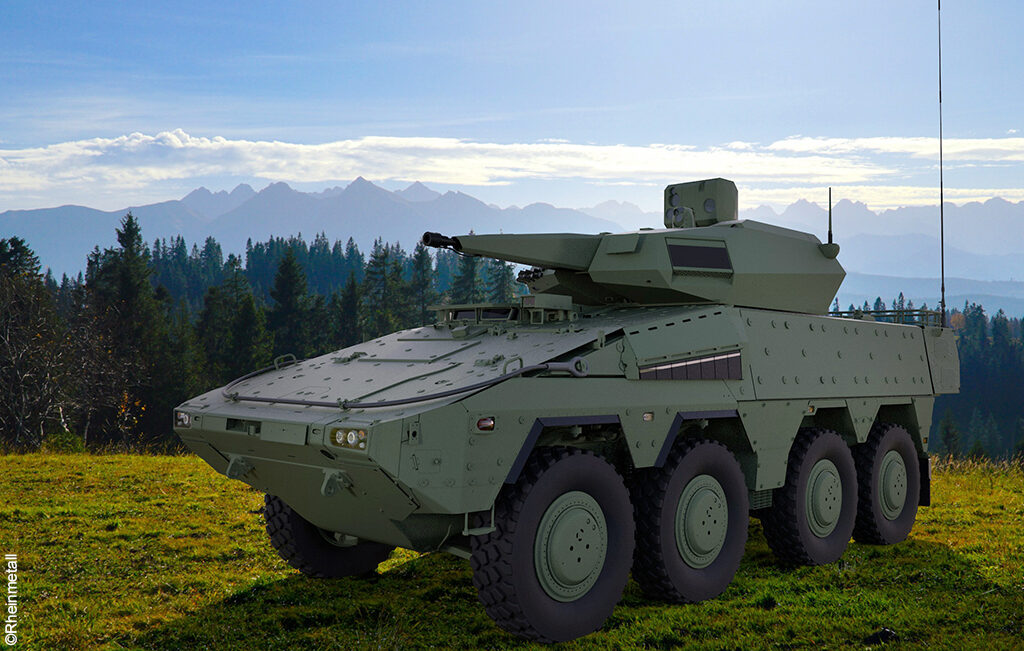 The Skyranger 30 anti-aircraft gun tank. Photo: Rheinmetall
Strengths
- Layered air defense: The combination of a programmable 30mm cannon and optional surface-to-air missiles enables the system to engage a broad spectrum of low-altitude threats at varying ranges.
- High counter-drone effectiveness: Programmable airburst ammunition and rapid-fire capability make the Skyranger 30 particularly well suited to defeating small, fast-moving drones and loitering munitions that can challenge traditional missile-based air defenses.
- Advanced sensor fusion: Integrated radar, electro-optical sensors, and optional infrared and tracking radars provide continuous 360-degree surveillance, with the SPEXER radar upgrade further enhancing target classification and tracking accuracy while the system is on the move.
- Flexible platform integration: Its unmanned, modular turret can be mounted on a variety of tracked and wheeled armored vehicles, allowing operators to tailor the system to existing fleets while simplifying future upgrades.
- Mobile force protection: Designed to move with mechanized formations, the Skyranger 30 provides close-range air defense without sacrificing the mobility needed for modern maneuver warfare.
Limitations
- Short-range focus: The system is designed to defend against low-altitude threats at relatively short distances and must operate alongside medium- and long-range air defense assets as part of a layered network.
- Platform-dependent performance: Mobility, protection, endurance, and transportability depend on the armored vehicle selected to carry the turret, resulting in different capabilities between operators.
- Network reliance: Although capable of operating independently, the Skyranger 30 achieves its greatest effectiveness when integrated with external sensors, command-and-control systems, and a broader air defense architecture.
- Limited combat record: As a relatively new system entering service, the Skyranger 30 has yet to build the extensive operational experience of many legacy short-range air defense platforms.
 The Skyranger 30 integrates 360-degree radar, electro-optical sensors, and optional infrared and tracking radars to detect, track, and engage multiple aerial threats in complex environments. Photo: Dutch Ministry of Defence
 Operators and Global Adoption
The Skyranger 30 has gained traction as European nations rebuild mobile air defense capabilities in response to evolving security threats. Current and announced operators include:
- Austria: Austria is procuring the Skyranger 30 on the Pandur EVO 6×6 armored vehicle to modernize the Austrian Armed Forces' mobile air defense capability.
- Denmark: Skyranger 30 will provide close-range protection for land forces and complement Denmark's wider integrated air and missile defense network.
- Germany: Germany is fielding the Skyranger 30 on the Boxer armored vehicle to restore mobile air defense for the Bundeswehr's mechanized formations. The system will also integrate MBDA's DefendAir counter-drone missile, significantly extending its engagement range against small unmanned aerial systems.
- Netherlands: The Netherlands has selected the Skyranger 30 to re-establish a mobile ground-based air defense capability for the Royal Netherlands Army after more than a decade without one.
- Hungary: Hungary became the launch customer for the Skyranger 30, selecting the turret for its Lynx KF41 infantry fighting vehicles as part of the Zrínyi Defense and Armed Forces Development Program.
Future Outlook
The Skyranger 30 is expected to play an increasingly important role as armed forces adapt to the widespread use of drones and other low-cost aerial threats.
Future developments are likely to focus on improved sensor performance, greater automation, enhanced integration with battlefield networks, and compatibility with emerging effectors.
As more countries modernize their ground-based air defense forces, the system's modular architecture and multi-platform compatibility position it as a strong contender for future SHORAD and counter-drone programs.
