
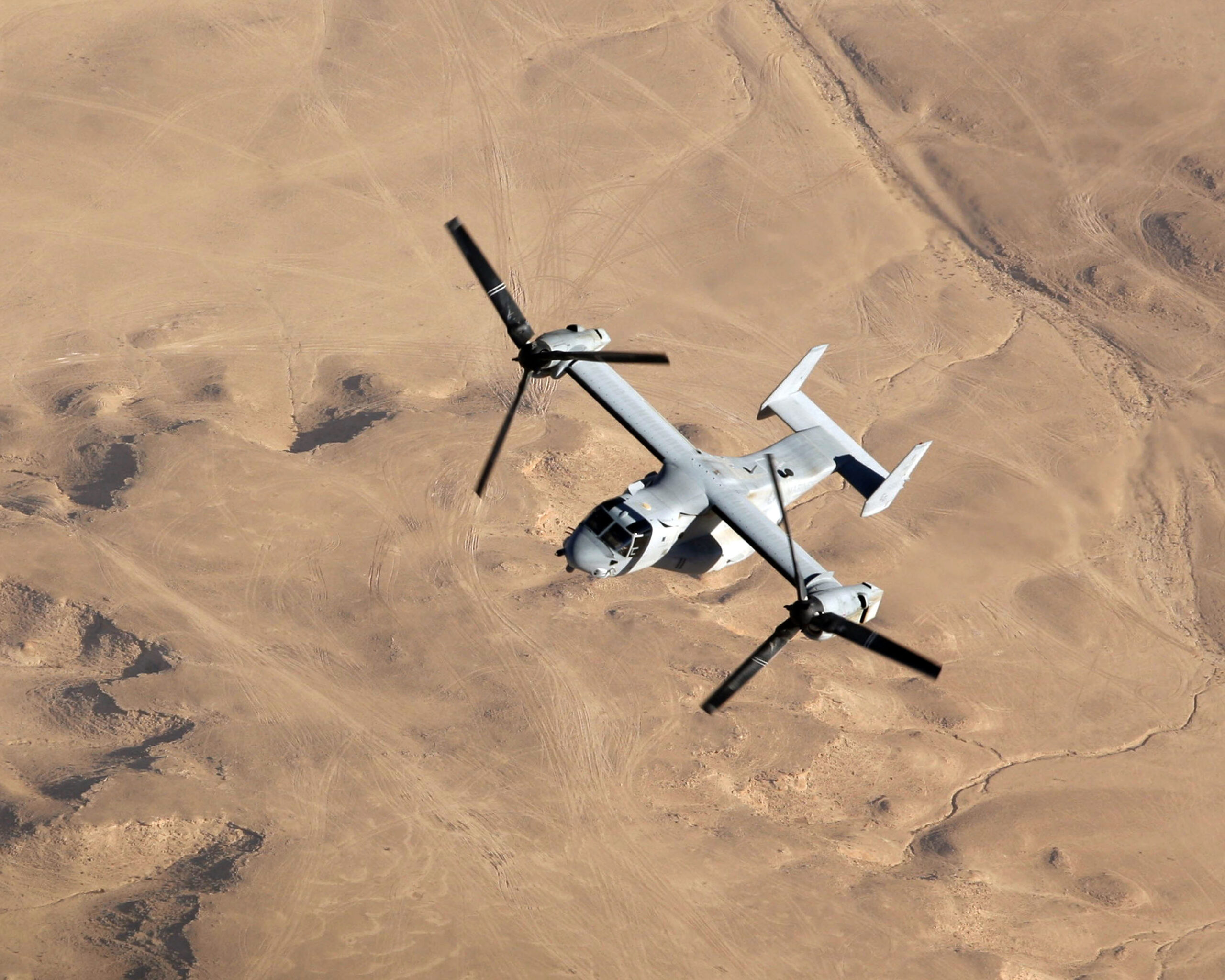


Neither a helicopter nor an airplane, the V-22 Osprey was designed to bridge the gap between the two. This guide examines the aircraft's unique tiltrotor design, operational history, and continuing role in military aviation.
The V-22 Osprey was built to overcome one of military aviation's longest-standing tradeoffs: helicopters can take off almost anywhere, but airplanes can travel farther and faster.
By combining both capabilities in a single tiltrotor aircraft, the Osprey has carved out a unique role in troop transport, special operations, and expeditionary warfare.
Its service history, however, has been shaped not only by its groundbreaking design but also by a series of accidents, technical challenges, and debates over cost and reliability.
This guide examines how the V-22 was developed, how it works, where it has been used, and the issues that continue to influence its future.
 An MV-22 Osprey demonstrates its vertical takeoff and landing (VTOL) capabilities aboard a Republic of Korea Navy assault ship. Photo: US Navy
At a Glance
What Is the V-22 Osprey?
The V-22 Osprey is a tiltrotor aircraft jointly developed by Bell and Boeing. It combines the vertical takeoff and landing capabilities of a helicopter with the speed, range, and efficiency of a turboprop airplane.
Unlike conventional helicopters, the Osprey's engines and rotors are housed in rotating nacelles at the ends of its wings. These nacelles can pivot between vertical and horizontal positions, allowing the aircraft to transition between hover and forward flight.
The innovative design has enabled capabilities unavailable to most traditional rotorcraft, but it has also been accompanied by technical challenges and a series of fatal accidents throughout its development and operational history.
Those incidents contributed to the aircraft's controversial reputation, with critics and some service members at times referring to it as the "widowmaker" despite its widespread adoption across multiple US military branches.
How Did the V-22 Come to Be?
The origins of the Osprey can be traced to the aftermath of Operation Eagle Claw, the failed 1980 US hostage rescue mission in Iran, which exposed the need for an aircraft capable of combining long-range, high-speed flight with vertical takeoff and landing.
The requirement led to the launch of the Joint-service Vertical Take-Off/Landing Experimental program, from which the V-22 ultimately emerged.
The aircraft made its first flight in March 1989, but translating its unconventional tiltrotor concept into an operational military platform required years of testing, engineering refinements, and validation.
The extended development pushed the program well beyond its original timeline before the V-22 finally entered service with the US Marine Corps in 2007.
Key milestones:
- March 1989: First flight of the V-22
- September 2005: Full-rate production granted
- October 2007: MV-22B combat debut
- July 2015: Bell Boeing wins US Navy contract for five V-22s to be delivered to Japan, the first international sale of the aircraft
- June 2020: First CMV-22B delivery to the US Navy
- June 2022: US Navy temporarily halts V-22 operations after a Class A aviation mishap
- December 2023: The House Committee on Government Oversight conducts an investigation into the program and holds a hearing on the issue a year later
- 2024: V-22 was reinstated with limitations, but it was grounded again in December after a near-crash incident in New Mexico
- July 2025: As of this date, over 65 personnel and civilians have died in mishaps involving the V-22
The V-22 Osprey Family
MV-22B (US Marine Corps)
This is the baseline production variant and the most numerous in service. Designed primarily for assault support, it transports Marines, equipment, and supplies during amphibious assaults, expeditionary operations, and humanitarian missions.
The MV-22B has also accounted for the majority of operational Osprey mishaps, with 23 of the 35 fatal accidents recorded after the aircraft entered service.
Despite this, its Class A mishap rate has generally been comparable to the Marine Corps aviation average over the same period, indicating that the platform's safety record has improved considerably since its troubled development.
CV-22B (US Air Force)
Operated by the US Air Force Special Operations Command (AFSOC), the CV-22B is optimized for long-range special operations.
It incorporates terrain-following radar, advanced navigation systems, enhanced communications, and additional fuel capacity for low-level infiltration, exfiltration, counter-drone, and personnel recovery missions.
Twelve of the 35 post-service fatal Osprey mishaps have involved the CV-22B. However, its Class A mishap rate, approximately 11.55 mishaps per 100,000 flight hours, has remained substantially higher than the Air Force-wide average of 1.65 per 100,000 flight hours, contributing to continued scrutiny of the variant's operational safety.
CMV-22B (US Navy)
It features extended-range fuel tanks and long-range communications tailored for naval logistics.
The navy has reported that its variant has not experienced mishaps or fatalities.
 The V-22 Osprey's combination of helicopter-like vertical lift and airplane-like speed has enabled rapid troop insertions, resupply missions, and medical evacuations during combat operations. Photo: Bell Flight
How Does the V-22 Work?
Key Features
Tiltrotor Technology
The Osprey's defining feature is its ability to rotate its engine nacelles 90 degrees. During takeoff and landing, the rotors point upward like a helicopter. Once airborne, they rotate forward, enabling faster and more efficient airplane-like flight.
High-Speed Vertical Lift
Traditional helicopters often face tradeoffs between speed and lift. The V-22 reduces that compromise by combining vertical lift with cruise speeds significantly higher than most military helicopters.
Shipboard Flexibility
The aircraft's folding wings and rotor blades allow it to operate from amphibious assault ships and aircraft carriers while minimizing storage space requirements.
Strengths
- Operational reach and speed: The V-22 can move personnel and equipment much farther and faster than most conventional helicopters.
- Expeditionary flexibility: By combining vertical takeoff and landing with airplane-like cruise performance, the Osprey can operate from amphibious ships, austere landing zones, and remote locations without requiring conventional runways.
- Enhanced force projection: The Osprey enables military forces to deploy troops, equipment, and supplies over greater distances in shorter timeframes, improving operational tempo and extending the reach of amphibious and expeditionary operations.
Limitations
- Persistent safety and reliability concerns: Although the aircraft's safety record has improved over time, a series of fatal accidents and mechanical failures has led to repeated fleet groundings, operational restrictions, and ongoing scrutiny.
- Complex maintenance requirements: The tiltrotor system is significantly more complex than the rotor systems found on conventional helicopters, increasing maintenance demands, sustainment costs, and the need for specialized technical expertise.
Where Has the V-22 Been Used?
Iraq and Afghanistan
The V-22 made its combat debut in Iraq in 2007 before expanding operations to Afghanistan. Its combination of speed, range, and vertical-lift capability allowed US forces to move troops, equipment, and casualties over long distances while reducing transit times and limiting exposure to roadside threats.
The aircraft became a key asset for assault support and special operations missions in both theaters.
Japan
Japan became the first international operator of the V-22, acquiring the aircraft to strengthen rapid deployment and the defense of its remote islands.
Stationed with the Japan Ground Self-Defense Force, the Osprey plays an increasingly important role in responding to regional contingencies and improving interoperability with US forces across the Indo-Pacific.
Carrier and Naval Operations
The V-22 has expanded the logistical flexibility of US carrier strike groups by enabling faster, longer-range resupply missions across the Indo-Pacific and other theaters.
Its ability to rapidly move personnel and mission-critical equipment between dispersed naval forces supports the navy's shift toward more distributed maritime operations, where ships are expected to operate over greater distances while remaining combat-ready.
 The V-22 Osprey has become a key asset for the US Marine Corps and US Special Operations Command, enabling long-range troop transport and rapid response missions across multiple theaters. Photo: Bell Flight
Future Outlook
More than three decades after its first flight, the V-22 remains the only military tiltrotor aircraft in large-scale operational service.
New variants continue to expand its mission set, while lessons learned from the program are influencing next-generation vertical-lift aircraft such as Bell's V-280 Valor.
Although debates over cost, maintenance, and safety continue, the Osprey has demonstrated that tiltrotor technology can provide capabilities that neither traditional helicopters nor fixed-wing transports can fully match.
As militaries place greater emphasis on speed, reach, and operational flexibility, the V-22's legacy is likely to shape vertical-lift aviation for decades to come.
