
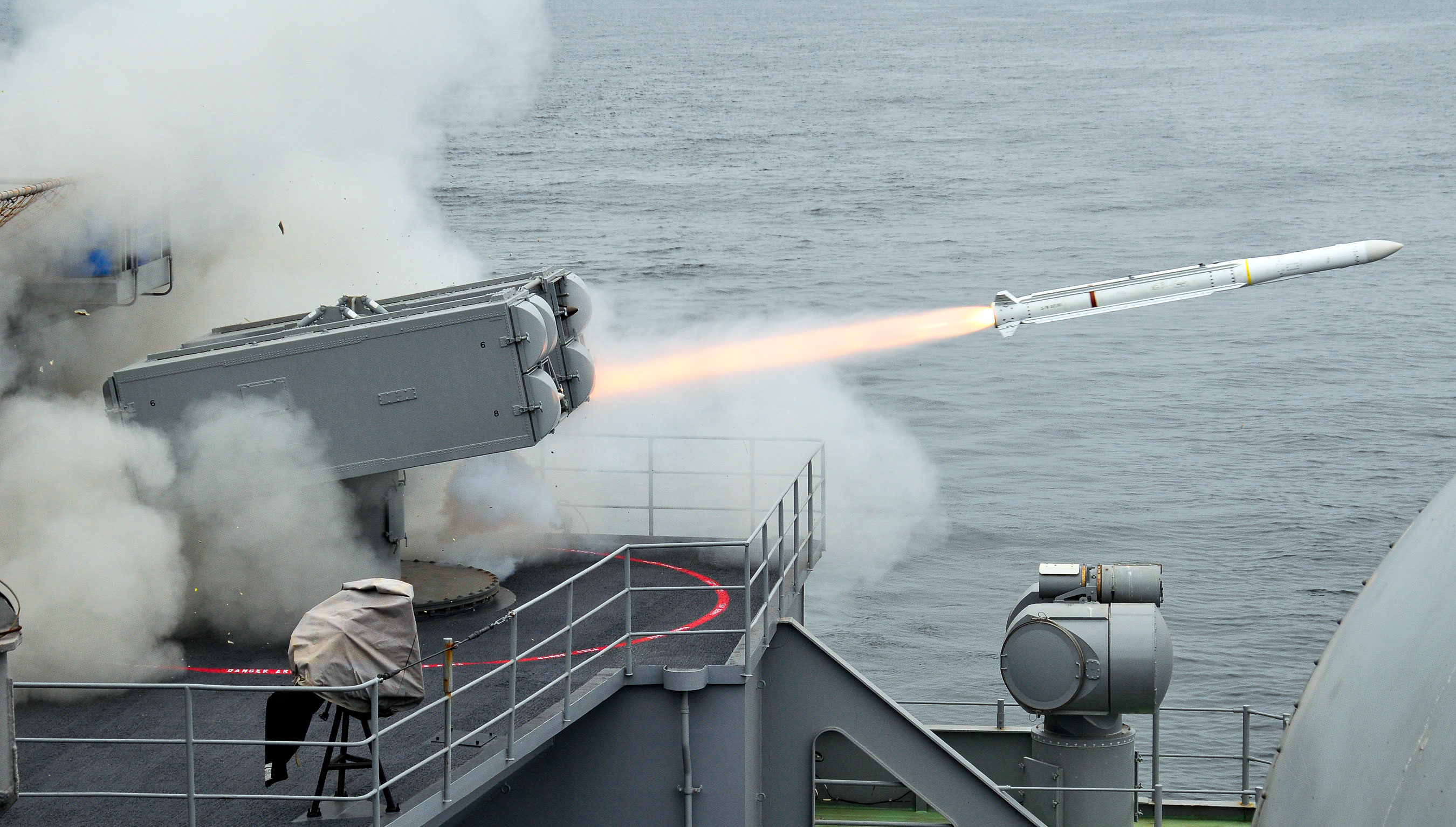


The US Navy is seeking companies to develop, produce, and provide in-service support for the Evolved SeaSparrow Missile Next Significant Variant.
The US Navy is seeking companies to develop, produce, and provide in-service support for the Evolved SeaSparrow Missile (ESSM) Next Significant Variant (NSV).
The ESSM is a ship-launched missile that protects surface combatants like aircraft carriers and amphibious assault ships from fast, low-flying, and maneuverable systems, such as aircraft, drones, and anti-ship missiles.
Its NSV must meet the requirements of the NATO SEASPARROW Project Office — a 12-nation consortium comprising Australia, Belgium, Canada, Denmark, Germany, Greece, Netherlands, Norway, Portugal, Spain, Turkey, and the US — responsible for the program.
Responses are expected until October 19.
ESSM NSV Requirements
According to a published sources sought notice, the ESSM NSV must be effective against several types of threats, with capabilities ranging from low- to high-speed, sea-skimming to high-altitude, and non-maneuvering to high-G maneuvers, across varying signatures.
It must be able to operate in complex and contested environments, as well as in radio-frequency, electro-optical, or infrared environments.
The missile should distinguish closely spaced targets, provide tracking data for guidance and lethality, and withstand enemy countermeasures.
The NSV must also feature a modern, open, flexible, and modular design to accelerate development and keep pace with fast-evolving threats.
It must fit within a 10-inch (25-centimeter) diameter for quad-packing in the Mk 41 vertical launch system or an equivalent launcher, while minimizing weight without compromising performance.
Moreover, the notice states that the ESSM NSV’s acquisition and design must align with a Modular Open Systems Approach.
This aims to give Washington the “maximum rights in technical data, computer software, and computer software documentation (including source code), design artifacts, and interface specifications under a license consistent with at least Government Purpose Rights under the Defense Federal Acquisition Regulation Supplement, or a similar deliverable model.”
