



Built to counter threats that are faster, farther-reaching, and more complex, the SM-6 has become a linchpin of the US Navy's layered defense. This guide explores its capabilities and growing role.
Modern naval warfare demands weapons that can counter multiple threats without relying on a different missile for every mission.
That need gave rise to the Standard Missile 6, or SM-6, one of the most versatile naval weapons in service today, which evolved into a multi-role missile capable of engaging aircraft, missiles, and surface targets alike.
Read on to learn how the SM-6 was developed, how it works, and why it has become a cornerstone of modern naval warfare.
At a Glance
 Standard Missile 6. Photo: Raytheon
What Is the SM-6?
The SM-6 represents the latest evolution of the US Navy's Standard Missile family, expanding the role of a fleet air-defense interceptor into a true multi-mission weapon.
It was developed to counter a rapidly evolving threat environment in which warships may have to defend against aircraft, sea-skimming cruise missiles, ballistic missiles, and hostile surface vessels during the same operation.
The missile is launched from the MK 41 Vertical Launch System on Aegis-equipped destroyers and, more recently, from the US Army's Typhon Mid-Range Capability launcher.
From these platforms, it can intercept fixed-wing aircraft, helicopters, anti-ship cruise missiles, and certain ballistic missiles during their terminal phase, while newer variants also provide long-range surface-strike capability.
The air-launched variant, designated the AIM-174B, was confirmed as operationally deployed by the US Navy in July 2024, making it the longest-range air-to-air missile ever fielded by the service. Carried externally on F/A-18E/F Super Hornets, it significantly extends the reach of carrier air wings beyond the range of any previous US Navy air-to-air missile.
Cost vs. Target Debate
As the SM-6 has taken on more missions, analysts have debated how best to employ one of the US military's most capable and costly interceptors.
At over $9 million per missile, using the SM-6 against inexpensive drones or low-end threats is difficult to sustain at scale — a concern that has grown as Houthi forces in the Red Sea demonstrated how cheaply adversaries can force expensive intercepts.
The debate has accelerated development of lower-cost defensive options for less demanding targets, while the SM-6 is increasingly reserved for the high-end threats, such as advanced cruise missiles, ballistic missiles, and anti-ship weapons, that justify its cost.
How the SM-6 Came to Be
Development of the SM-6 began in the early 2000s after the navy identified the need for a missile capable of countering increasingly sophisticated aircraft and cruise missile threats while extending the reach of the Aegis Combat System.
The service awarded the development contract to Raytheon (now RTX), which built on decades of experience producing the Standard Missile family rather than pursuing an entirely new design.
Instead, Raytheon combined the proven airframe and propulsion of the SM-2ER Block IV with an active radar seeker adapted from the AIM-120 AMRAAM air-to-air missile.
The SM-6 completed its first successful intercept in 2008 before achieving initial operational capability with the US Navy in 2013. Since then, the missile has steadily expanded beyond its original air-defense mission.
Today, the SM-6 is regarded as one of the US Navy's most versatile ship-launched missiles, with newer variants such as the Block IB further extending its range and speed.
 The SM-6 AIM-174B Air Launch Capability pairs the shipboard missile with the US Navy's F/A18 Super Hornet. Photo: Raytheon
SM-6 Variants
SM-6 Block I
The original production variant established the SM-6 as a long-range fleet defense missile, combining extended reach with an active radar seeker to engage aircraft and sea-skimming cruise missiles beyond the ship's radar horizon.
It also introduced a limited capability to intercept ballistic missiles during their terminal phase.
SM-6 Dual I
The Dual I upgrade transformed the SM-6 into a true dual-mission interceptor by enhancing its ability to defeat terminal-phase ballistic missiles without sacrificing its long-range air defense role.
The result was a single missile capable of responding to both aerodynamic and ballistic threats.
SM-6 Block IA
Rather than expanding the missile's mission set, the Block IA focused on improving its performance.
Updated electronics, processors, and internal components increased reliability, simplified maintenance, and enhanced resilience against increasingly complex and contested threat environments.
SM-6 Block IB
The Block IB represents the most significant leap in capability to date. A larger 21-inch (53-centimeter) rocket motor dramatically extends the missile's speed and range, enabling earlier engagements against high-end threats while strengthening its effectiveness in long-range air defense, ballistic missile defense, and offensive anti-surface strike missions.
How the SM-6 Works
Key Features
The SM-6 combines the propulsion system of the SM-2ER Block IV with an active radar seeker derived from the AIM-120 missile.
This gives it a key advantage over earlier Standard Missile variants, particularly the SM-2, by allowing the missile to acquire and track targets independently during the final stage of flight instead of relying solely on continuous radar illumination from the launching ship.
The SM-6 also uses a layered guidance approach. After launch, it navigates toward the target using inertial guidance while receiving updates from shipboard sensors and networked assets. During the final stage, its active radar seeker autonomously acquires and tracks the target.
The missile can also leverage sensor data from aircraft, ships, and other platforms, allowing it to engage threats beyond the launching vessel's radar horizon.
Strengths
One of the greatest strengths of the SM-6 is versatility. A single missile type can perform multiple missions, reducing logistical complexity aboard warships.
Its long range, high speed, and network-enabled targeting capabilities also make it effective against diverse threats, from enemy aircraft to advanced cruise missiles and certain ballistic missiles.
Limitations
Despite its flexibility, the SM-6 is an expensive weapon compared to shorter-range interceptors. Its sophisticated technology and advanced seeker contribute to higher procurement costs.
Like all missile defense systems, its effectiveness can also be challenged by large-scale saturation attacks involving numerous simultaneous targets.
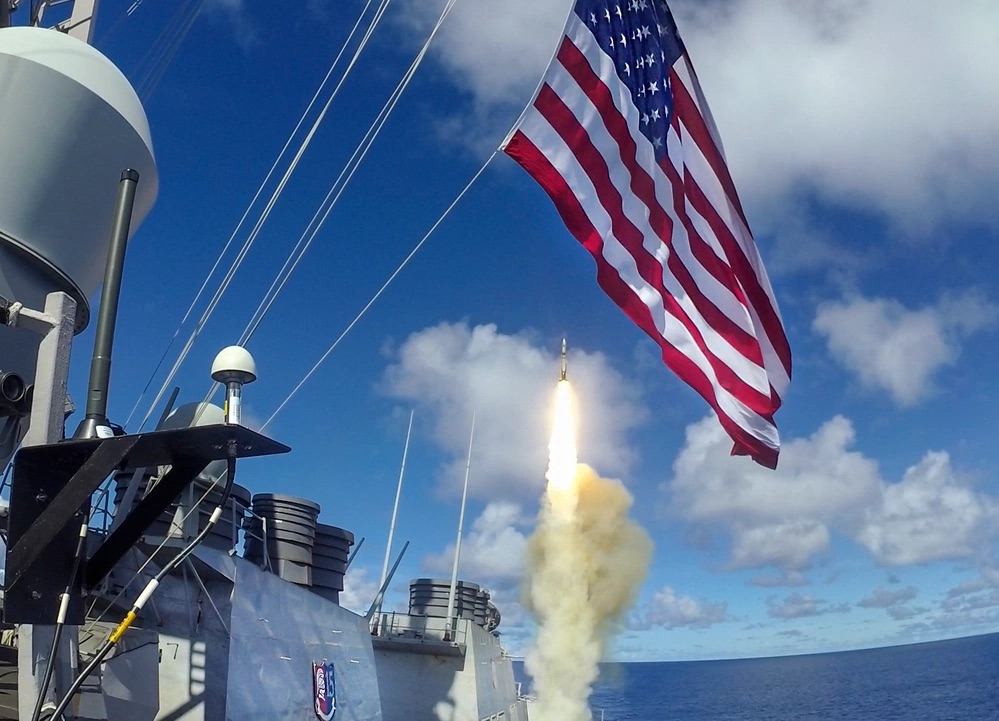 The Arleigh Burke-class guided-missile destroyer USS Barry (DDG 52) launches a Standard Missile 2 during a live-fire missile exercise. Photo: Mass Communication Specialist 1st Class Deanna Gonzales/US Navy
Global Use and Operational Employment
Beyond routine deployments, the SM-6 has repeatedly demonstrated new operational capabilities through fleet exercises and live-fire testing.
In 2016, it completed the longest over-the-horizon intercepts ever achieved by a Standard Missile. The year after, an SM-6 fired from the USS John Paul Jones successfully intercepted a medium-range ballistic missile during its terminal phase.
More recently, a 2024 test aboard the USS Preble verified upgraded Block IA software by destroying a sophisticated medium-range ballistic missile target at sea.
The missile has also been employed in operational combat, including intercepting hostile missiles and drones launched by Houthi forces in the Red Sea, underscoring its value in defending warships against real-world attacks.
Future Outlook
The future of the SM-6 is closely tied to the evolution of naval warfare. Emerging threats such as hypersonic weapons, advanced cruise missiles, and long-range precision strikes are driving demand for faster and more capable interceptors.
With the introduction of the SM-6 Block IB and continued integration into networked combat systems, the missile is expected to remain a cornerstone of US and allied naval defense strategies for years to come.
Its ability to perform multiple missions with a single weapon ensures that the SM-6 will continue adapting to the challenges of an increasingly complex battlespace.
