
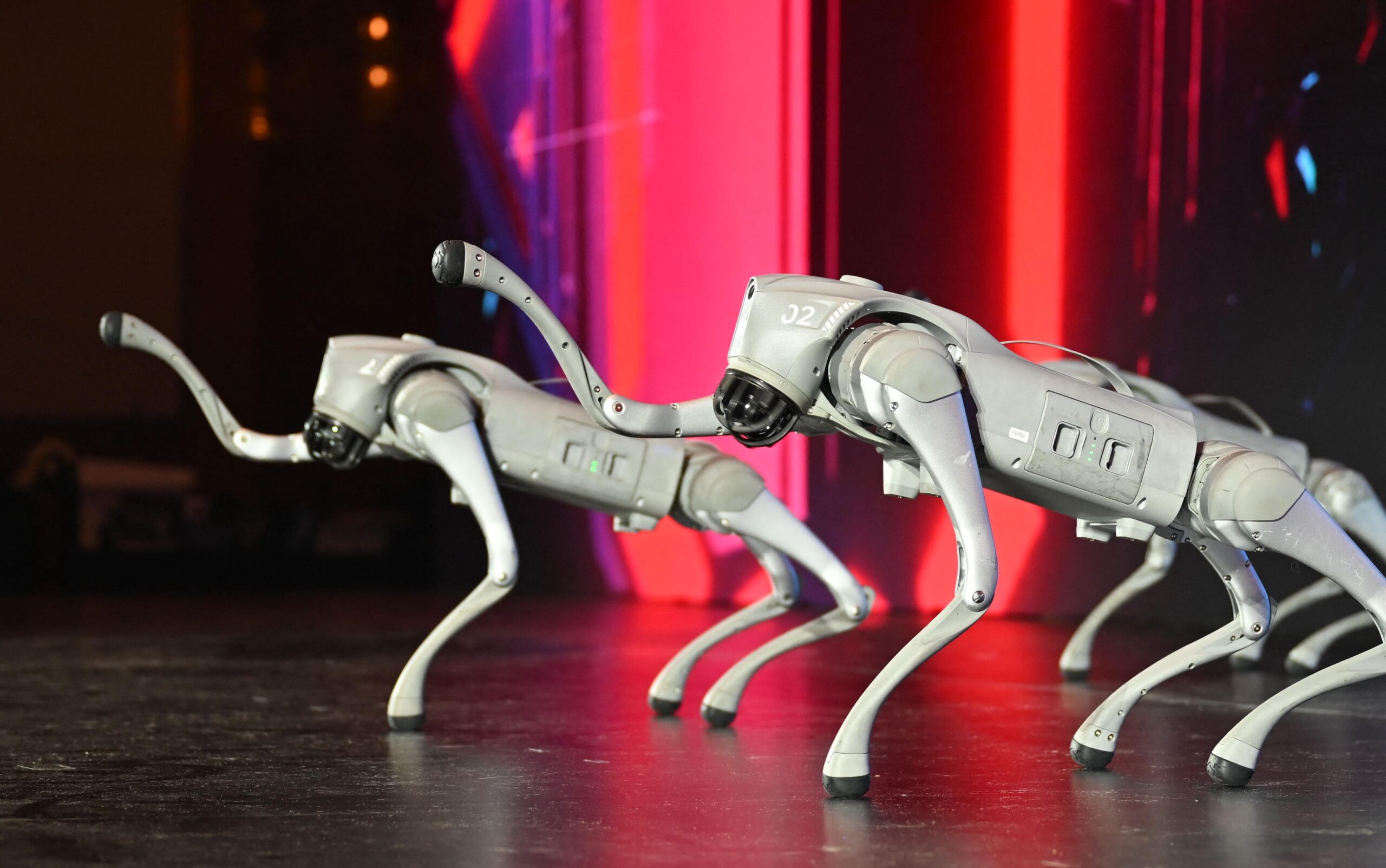


A team of Chinese military scientists is proposing to equip the country’s robot dogs with controversial thermobaric weapons to enhance urban warfare capabilities.
A team of Chinese military scientists is proposing to equip the country’s quadrupedal unmanned ground vehicles (Q-UGVs) with controversial thermobaric weapons to enhance urban warfare capabilities.
The idea follows a recent People’s Liberation Army drill, in which robot dogs reportedly struggled to flush out enemies from buildings and underground bunkers using light weaponry.
The dense GPS jamming and electromagnetic interference in modern cities have also become a major challenge for traditional weapon systems.
In response, the scientists argue that weapons of mass destruction, second only to nuclear arms in lethality, must be deployed when infiltrating fortified structures.
To achieve “comprehensive annihilation,” the proposal suggests drones with photoelectric and radar systems act as “eyes and commanders,” while robot dogs serve as “armored beasts” to purge underground complexes.
‘A Mini-Nuke’
Scientists from China’s National University of Defense Technology have described thermobaric weapons as a “mini-nuke” without radiation.
Their power derives from dispersing an aerosol cloud of gas, liquid, or powdered explosive — strong enough to collapse buildings and rupture human organs.
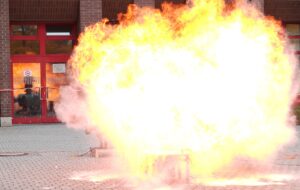 Sample explosion of a thermobaric weapon. Photo: Hans-Peter Scholz / Wikimedia Commons
Thermobaric weapons, or vacuum bombs, are typically fired from handheld launchers but can also be mounted on mobile platforms like Q-UGVs.
Due to their destructive power, these weapons face ethical scrutiny, as their use can result in indiscriminate damage and severe civilian casualties.
Russia has previously claimed to have used thermobaric weapons to eliminate a large number of targets in Ukraine.
