


Japan and South Korea will compete in arms exports, but the threats they share make rivalry without coordination self-defeating.
Japan’s decision to loosen its long-standing restrictions on arms exports is one of the most consequential strategic shifts in East Asia since the Cold War.
Under Prime Minister Takaichi Sanae, Tokyo has opened the door to lethal weapons exports for 17 partner countries, including the US, UK, and key Indo-Pacific security partners.
This is not a marginal policy adjustment but marks Japan’s transformation from a country defined by postwar pacifism into one willing to function as a proactive security provider in an increasingly unstable region.
For South Korea, the implications are both competitive and strategic.
At first glance, Japan’s entry into the arms export market threatens a position Seoul has spent decades building.
But beneath the industrial rivalry lies a more important reality: Japan and South Korea now face identical structural threats from China, North Korea, and Russia.
In that environment, the choice between competition and cooperation is not abstract but has direct consequences for regional deterrence.
The End of Japan’s Strategic Absence
For decades, South Korea benefited from Japan’s self-imposed absence from the global arms market.
Tokyo’s Three Principles on Transfer of Defense Equipment and Technology kept Japanese firms out of international competition, despite world-class capabilities in naval engineering, aerospace, sensors, and missile technology.
Seoul filled that vacuum aggressively. South Korean defense firms built a reputation as suppliers able to deliver modern weapons systems quickly, affordably, at scale, and with proven capabilities.
The Philippines, the UAE, Australia, and multiple European countries have all purchased South Korean platforms, with the K2 Black Panther, K9 howitzer, air-defense systems, and naval vessels among them.
Japan’s policy shift changes the equation. Countries considering advanced defense acquisitions can no longer be assumed to default to South Korean suppliers. Southeast Asia and Australia are the most likely early battlegrounds.
 The K9 mobile howitzer. Photo: Hanwha Defense USA
Why South Korea Still Holds Crucial Advantages
Japan’s entry will not translate into immediate market dominance. South Korean firms hold structural advantages that Tokyo cannot replicate quickly.
Speed and price are the most immediate.
South Korean companies have built an international reputation for delivering systems on schedule at costs well below comparable Western alternatives — a critical selling point as countries scramble to modernize amid accelerating geopolitical instability.
South Korea also offers something many competitors do not: genuine technology transfer.
Seoul has repeatedly structured deals to include local production lines, industrial knowledge-sharing, personnel training, and integration of partner-country firms into the supply chain.
This approach has proved especially persuasive in the Middle East and Eastern Europe, where buyers want to build domestic industrial capacity, not just import hardware.
Japan, by contrast, faces serious structural constraints. Arms exports require navigating elaborate approval processes, rigid end-use monitoring requirements, and significant domestic political resistance.
Japanese defense firms also lack the export-oriented culture and accumulated experience that South Korean companies have developed over decades.
In scalable land systems, ammunition production, and armored platforms — the bread-and-butter of most international procurement — Japan is unlikely to pose a serious competitive threat in the near term.
Where Competition Will Intensify
Japan’s competitive threat is concentrated in high-end sectors: naval systems, missile technology, aerospace, sensors, and electronic warfare.
Here, Tokyo’s deep integration with US defense technologies, advanced precision manufacturing, and decades of specialized engineering give it genuine advantages.
The clearest early signal came from Australia’s general-purpose frigate competition, where Japanese firms outperformed South Korean competitors. That outcome revealed something important: arms exports are increasingly decided not just by capability and price, but by diplomatic trust, strategic alignment, and broader geopolitical relationships.
Japan’s participation in the Global Combat Air Programme (GCAP) alongside the UK and Italy could compound this over time, creating meaningful long-term competition in aerospace markets where strategic alignment shapes procurement decisions as much as technical merit.
Drone technology and unmanned systems could become another critical area for rivalry. South Korea holds current operational and production advantages, but Japan’s broader industrial base gives it substantial long-term potential if investment continues.
 South Korean drone. Photo: DAPA
The Strategic Imperative for Cooperation
China’s military expansion, North Korea’s missile and nuclear development, and the deepening partnership between Moscow and Pyongyang have collectively narrowed the strategic options available to both Tokyo and Seoul.
The growing probability of a simultaneous crisis—a Taiwan contingency concurrent with North Korean opportunism on the Korean Peninsula—deepens the pressure further.
Under that scenario, US forces would face severe resource constraints across multiple theaters. Both Japan and South Korea would be left managing serious threats with fewer guaranteed American resources than their current planning assumptions allow.
This is the strategic context in which competition between Tokyo and Seoul becomes not just economically suboptimal but actively counterproductive. Two countries facing the same adversaries, in the same region, at the same time, cannot afford to treat each other as the primary problem.
From Rivalry to Division of Labor
The most strategically valuable outcome is a practical division of labor.
South Korea concentrates on scalable land systems, ammunition production, and armored platforms, while Japan specializes in advanced maritime systems, sensors, missile technology, aerospace components, and high-end electronic devices.
This framework produces concrete strategic benefits.
First, it expands the aggregate defense industrial capacity of US allies in East Asia, signaling credibility to regional adversaries, including under multi-contingency scenarios that would stress American resources across theaters.
Second, it reduces redundancy, allowing each country to allocate investment where it holds genuine comparative advantage rather than duplicating capability.
Third, closer industrial coordination improves supply chain resilience during crises. The Ukraine War has made the lesson unmistakable: industrial sustainment and ammunition production are as strategically decisive as battlefield technology.
Finally, deeper trilateral defense industrial integration — Washington, Tokyo, and Seoul — directly alleviates the growing burden on US defense resources. As America manages simultaneous strain across Europe, the Middle East, and the Indo-Pacific, allied industrial integration is no longer a diplomatic nicety but an operational necessity.
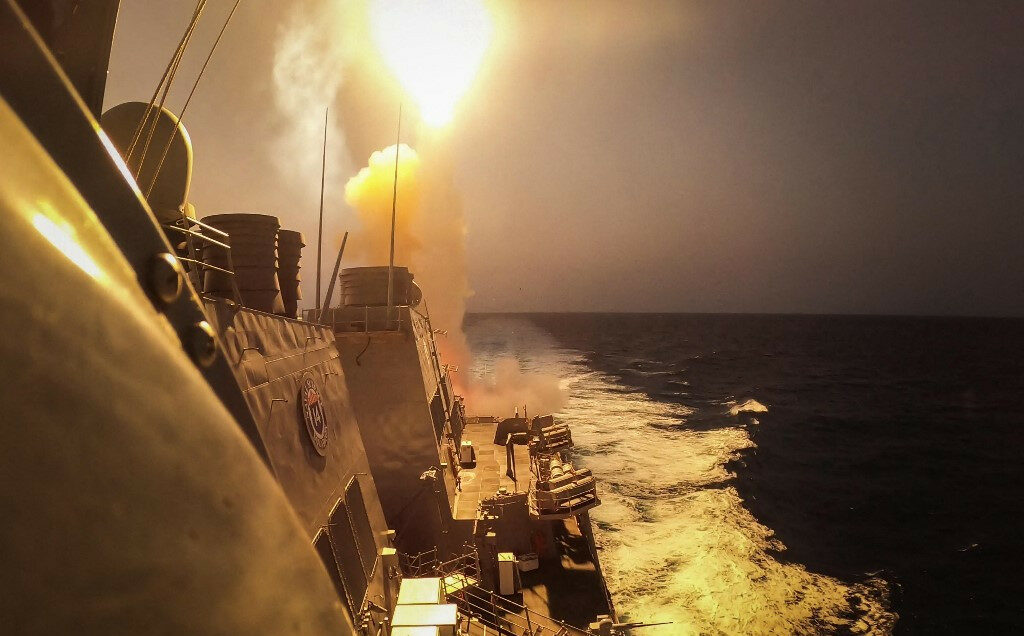 A US warship targeting Houthi strikes in the Red Sea, October 2023. Photo: US Navy
Political Obstacles Remain Real
The strategic logic for cooperation is clear. The political path is not.
Historical grievances remain live political liabilities in South Korea, not distant historical memories. The domestic sensitivities of Japan’s colonial past remain deeply rooted within South Korean politics and the public at large.
Japan faces its own domestic constraints. A significant portion of the Japanese public (over 48 percent) remains uncomfortable with expanded arms exports and the broader shift toward defense normalization.
The political legitimacy of becoming a major arms exporter is not yet settled within Japan’s own domestic debate. Overcoming those reservations will take years, not months.
Neither set of obstacles is insurmountable. The deteriorating regional security environment is, if anything, the most powerful argument for setting them aside.
Partnership or Crisis
Tokyo’s arms export decision is not primarily a commercial story. It is a signal that the postwar security order in East Asia is being renegotiated in real time.
China’s military rise, North Korea’s expanding capabilities, the Moscow-Pyongyang partnership, and the real possibility of simultaneous crises are collectively foreclosing the option of strategic inaction for both Japan and South Korea.
Under these conditions, rivalry between Tokyo and Seoul is a luxury neither can afford.
The relevant question is not whether they will compete; they will. It is whether they can build enough strategic trust, and enough political will, to structure a complementary defense industrial partnership before the regional environment makes that choice for them.

Dr. Ju Hyung Kim currently serves as the President at the Security Management Institute, a defense think tank affiliated with the South Korean National Assembly.
He has been involved in numerous defense projects and has provided consultation to several key organizations, including the Republic of Korea Joint Chiefs of Staff, the Defense Acquisition Program Administration, the Ministry of National Defense, the Korea Institute for Defense Analysis, the Agency for Defense Development, and the Korea Research Institute for Defense Technology Planning and Advancement.
He holds a doctoral degree in international relations from the National Graduate Institute for Policy Studies in Japan, a master’s degree in conflict management from the Johns Hopkins University School of Advanced International Studies, and a degree in public policy from Seoul National University’s Graduate School of Public Administration.
Dr. Kim has published extensively across leading international security and defense platforms, including The Diplomat, War on the Rocks, the Modern War Institute, 38 North, Asia Times, Small Wars Journal, RealClearDefense, Modern Diplomacy, the Lowy Institute, Global Security Review, the Geopolitics, and Global Defense Insight, among others.
The views and opinions expressed here are those of the author and do not necessarily reflect the editorial position of The Defense Post.
The Defense Post aims to publish a wide range of high-quality opinion and analysis from a diverse array of people – do you want to send us yours? Click here to submit an op-ed.
