



Discover the Black Hornet guide, detailing its pocket-sized form, real-time surveillance features, and how it supports troops with close-range situational awareness.
A soldier presses a small controller, and something no larger than a sparrow lifts into the air. It slips through a doorway, hovers down a narrow alley, and streams live video back to the squad waiting outside.
There’s no roar of engines, no radar signature to track — just a quiet, palm-sized aircraft gathering critical intelligence.
This is the Black Hornet, a nano unmanned aerial system (UAS) designed to give small units eyes beyond line of sight. Lightweight, discreet, and combat-proven, it has reshaped how infantry units conduct reconnaissance.
Here’s how it works and why it matters.
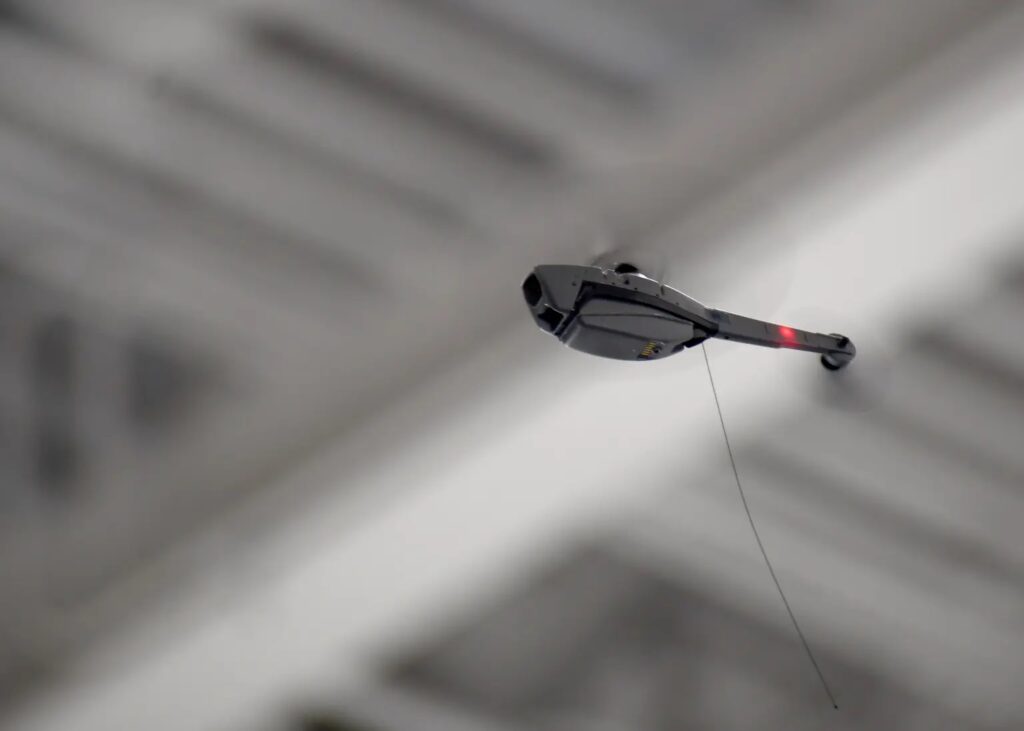 The Black Hornet 3 lightweight drone. Photo: Master Sgt. Warren W. Wright Jr./US Army
What Is the Black Hornet?
The Black Hornet is a pocket-sized reconnaissance drone developed to provide close-range situational awareness for troops.
Weighing just a few dozen grams, it is one of the smallest operational military drones in the world.
It is currently produced by Teledyne FLIR Defense, which acquired the original Norwegian developer Prox Dynamics in 2016.
The system consists of:
- One or more nano drones
- A handheld controller with display
- A docking/charging station
It is designed primarily for tactical reconnaissance in urban, complex, or confined environments.
How It Came to Be
The Black Hornet originated in the early 2010s, developed by Prox Dynamics to solve a specific battlefield challenge: giving small units real-time intelligence without exposing soldiers to enemy fire.
After its acquisition by Teledyne FLIR, the system evolved through multiple generations, incorporating improved sensors, extended range, and enhanced durability.
The system has since been adopted by numerous armed forces, including the United States and several NATO allies.
Variants
While all Black Hornet systems share the same core concept, there are generational upgrades:
- Black Hornet 2: Early operational model with basic day camera capability.
- Black Hornet 3: Added thermal imaging and improved digital data link.
- Black Hornet 4: Latest generation featuring better flight performance, extended endurance, and improved imaging clarity.
Each iteration enhances survivability, imaging, and operational flexibility while maintaining its ultra-compact design.
How It Works
The Black Hornet operates as a short-range ISR platform, transmitting live video and still imagery directly to the operator.
Key Features
- Ultra-small form factor: Difficult to detect visually or acoustically.
- Dual-sensor payload: Day and thermal imaging.
- GPS-assisted navigation: Stable hover and waypoint capability.
- Encrypted digital link: Secure transmission of intelligence data.
Strengths
- Reduces soldier exposure: Enables reconnaissance before entering buildings or terrain features.
- Rapid deployment: Launches in seconds.
- Urban dominance: Effective in tight alleys, rooftops, and interior spaces.
- Low logistics burden: Lightweight and easily carried by infantry.
Limitations
- Limited endurance: Around 30 minutes per sortie.
- Weather sensitivity: Wind and heavy rain can degrade performance.
- Short-range ISR: Designed for tactical, not strategic, reconnaissance.
Despite these constraints, it excels in its intended role: close-range intelligence gathering.
 The Black Hornet’s ultra-compact size allows soldiers to carry it easily and deploy it quickly for immediate reconnaissance in tight spaces. Photo: Sgt. Olivia Cowart/US Army
Global Use and Operational Deployment
The Black Hornet has been purchased and fielded by multiple NATO members and allied forces, including Switzerland, Germany, and Norway.
It has been used in combat environments for urban reconnaissance, route clearance support, and perimeter security.
The US Army has deployed the system at the squad and platoon level, emphasizing its value in distributed operations.
Other countries have adopted it for both military and special operations forces, where stealth and portability are paramount.
Its operational history demonstrates how nano drones can significantly enhance situational awareness at the lowest tactical levels.
Future Outlook
As militaries continue investing in multi-domain operations and decentralized warfare, nano drones like the Black Hornet are likely to become standard equipment.
Future iterations may incorporate:
- AI-assisted target recognition
- Extended endurance batteries
- Enhanced autonomous navigation
- Improved resilience in contested electronic environments
The broader trend is clear: smaller systems delivering faster, more precise intelligence at the edge of the battlefield.
The Black Hornet proves that battlefield impact doesn’t depend on size. By shrinking reconnaissance down to something that fits in a cargo pocket, it has fundamentally changed how small units see — and survive — in complex environments.
 Black Hornet nano drone. Photo: Teledyne FLIR Defense