
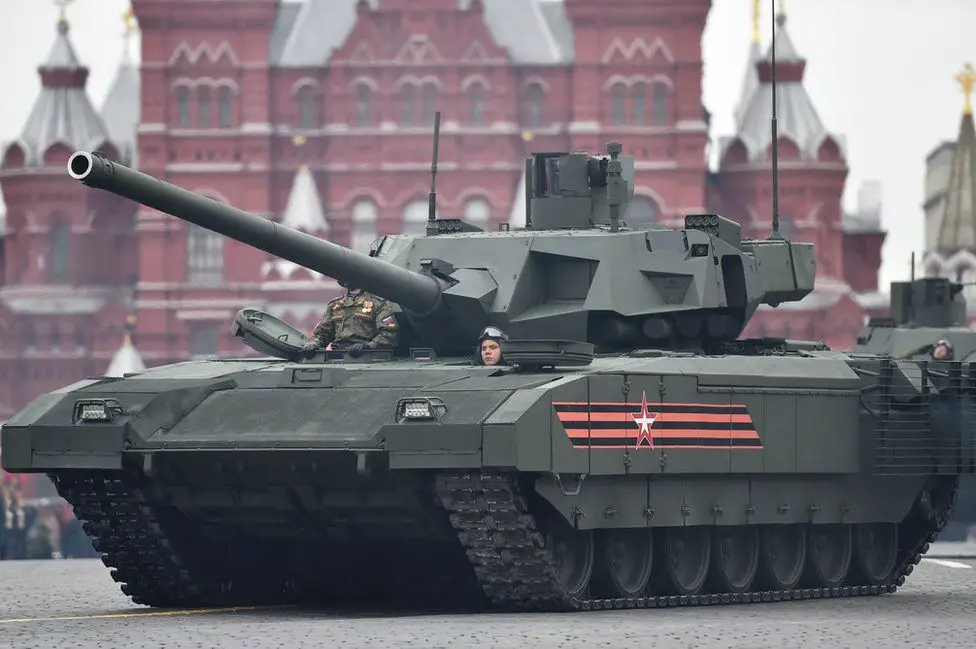


The Russian military will use its next-generation tank series, the T-14 Armata, as the basis for the practice and improvement of warfare tactics.
The Russian military will use its next-generation tank series, the T-14 Armata, as the basis for the practice and improvement of warfare tactics, the country announced.
Mikhail Osyko, a member of Russia’s Military-Industrial Commission which is tasked with implementing state policy on military-industrial issues, told TASS that the Armata tanks will be used to “practice and improve combat employment tactics.”
The tanks “cover all of the Russian Army’s needs for this hardware,” he said, including for units stationed in the Arctic region. “For example, the T-80 tank is to a great extent used in northern latitudes," he added.
Aside from utilizing new generations of tanks for improving warcraft tactics, the commission member also said the Russian tank-building industry has worked on the “technology for repairing and upgrading all basic combat vehicles in service.”
The T-14 Armata Tank
The T-14 Armata is Russia’s newest generation of main battle tanks based on the Armata Universal Combat Platform. It is manufactured by Russian machine company Uralvagonzavod, with each unit valued at around $3.7 million, or around 275.5 million Russian rubles.
The Armata is manned and operated by three crew members. It has a gross mass of 55 tonnes (55,000 kg), is 8.7 m (29 ft) long, 3.5 m (11 ft) in width, and 3.3 m (11 ft) tall.
It uses a 2A82-1M 125 mm (4.92 in) smoothbore cannon with 45 rounds as its main armament, 12.7 mm (0.50 in) Kord machine gun (6P49), and 7.62 mm (0.30 in) PKTM machine gun (6P7К) as the secondary armament.
The vehicle has an operational speed range of up to 500 km (310.6 mi.) and a maximum speed range of 90 km/h (56 mph).
Earlier this month, the country announced the Russian Army will receive 20 of the tanks by the end of this year. Russia will start mass production of T-14 Armata tanks starting next year.
