
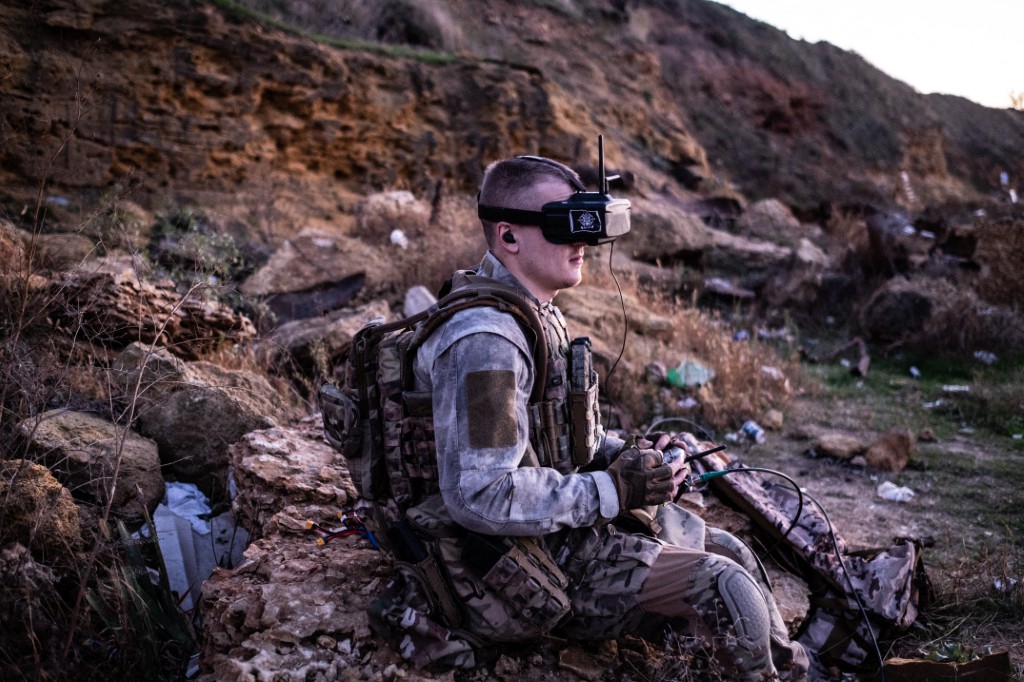


Ukraine has updated its basic military training program to place greater emphasis on defending against first-person view drones.
Ukraine has updated its basic military training program to place greater emphasis on defending against first-person view (FPV) drones, local news outlet Mezha reported.
The revised course lasts 51 days and prioritizes practical combat skills tailored to modern battlefield conditions.
Within 402 hours of instruction, 367 hours are for practical training, with part of the course focusing on countering drone threats and training recruits in the use of small arms.
Participants complete 137 hours of firearms training, firing more than 940 live rounds while practicing shooting from different positions and clearing weapon malfunctions.
Upon completion of the course, recruits receive a “Rifleman” qualification and are then assigned to combat units or sent for further specialized training.
 First-person view drones flying in a swarm formation. Image: Peter Bannister/DVIDS
Enhancing Training Capabilities
The program covers a range of battlefield skills required for emerging needs in front-line operations.
It includes training with pump-action shotguns, which can be used at short range against low-flying FPV drones when electronic warfare systems are ineffective.
Engineering training includes building and organizing trench systems and camouflaging positions from drone and thermal-imaging detection.
It also covers basic survival conditions at forward positions, including maintaining hygiene and conserving water.
Tactical training focuses on small-unit operations, including trench clearing and movement under simulated combat pressure.
Recruits also undergo psychological stress drills to prepare them to make decisions in high-intensity situations.
The course culminates in a three-day field exercise featuring a forced march, land navigation, nighttime operations, and simulated attacks, with trainees required to monitor potential aerial threats.
