


Europe's next main battle tank is being built from the ground up for a digital battlefield: crewed-uncrewed teaming, networked fires, and a rethink of what armor is even for. This guide covers it all.
The tank is no longer defined purely by armor thickness or main gun caliber, but by how well it operates inside a networked battlespace shaped by sensors, precision-guided threats, and unmanned systems.
At the center of Europe’s response to this evolution is the Main Ground Combat System (MGCS), a long-term effort led by France and Germany to rethink how armored power is structured, connected, and deployed on the modern battlefield.
Here’s how the MGCS came to be, what it is intended to deliver, and why it represents one of the most ambitious land warfare programs currently in development.
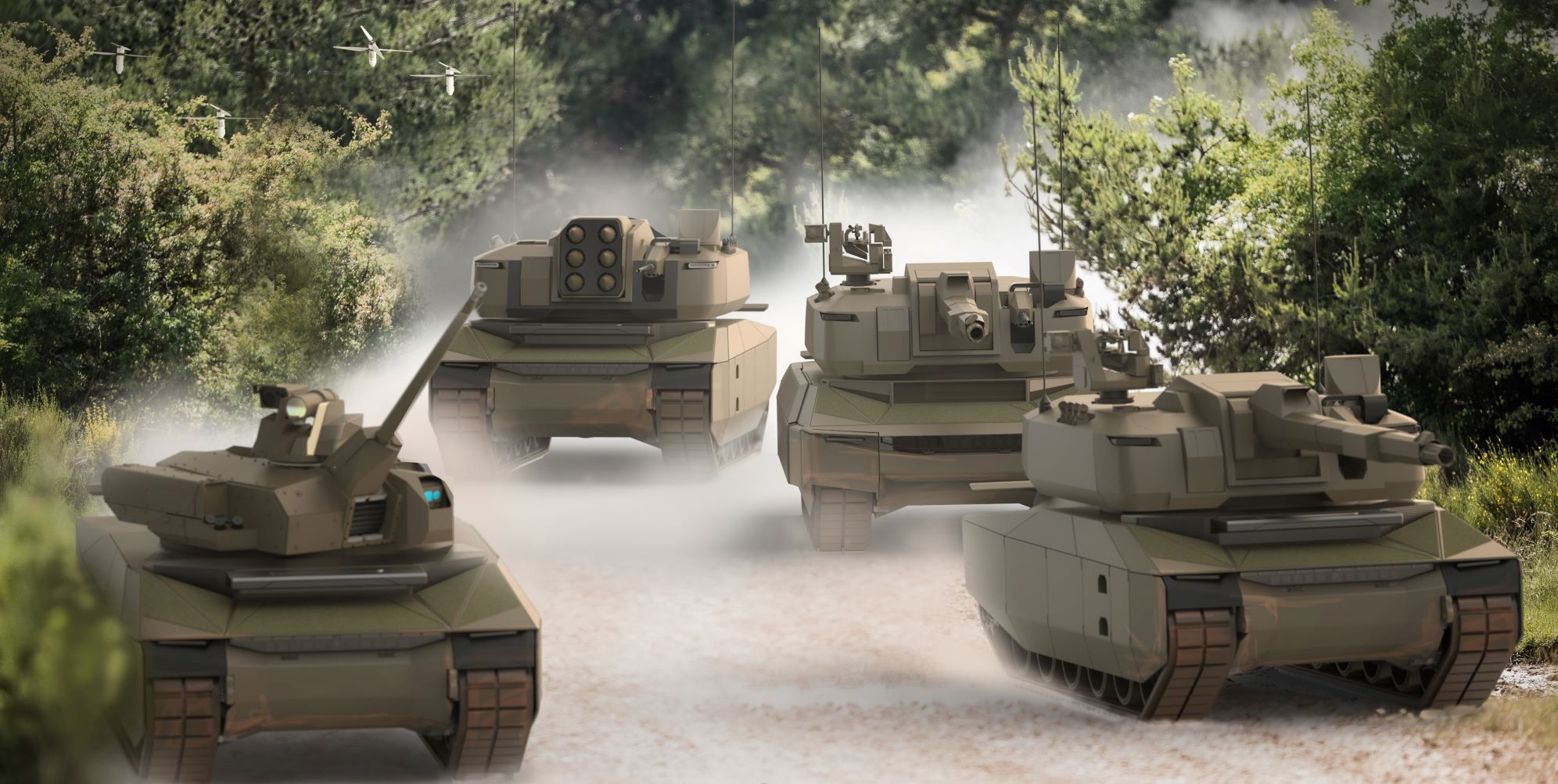
 The Main Ground Combat System is designed to combine advanced armor, AI-enabled systems, and networked battlefield coordination. Photo: Hensoldt
What Is MGCS (Main Ground Combat System)?
The Main Ground Combat System, or MGCS, is a multinational European defense program aimed at developing a next-generation armored warfare system to eventually replace the French Leclerc and German Leopard 2 main battle tanks.
Rather than a single vehicle, MGCS is envisioned as a system-of-systems that combines manned armored platforms, unmanned ground vehicles, advanced sensors, and networked command systems.
Its core goal is to ensure armored forces remain relevant in an environment shaped by drones, precision-guided munitions, and layered anti-tank systems.
Origins and Strategic Purpose of MGCS
The idea behind MGCS emerged from growing recognition that existing main battle tanks, while highly capable, were increasingly vulnerable on the modern battlefield.
Conflicts in Ukraine and the Middle East highlighted the growing threat posed by loitering munitions, anti-tank guided missiles, and networked reconnaissance systems.
Rather than incrementally upgrading legacy platforms, France and Germany opted for a long-term structural solution: the MGCS program.
MGCS: System-of-Systems Concept
Unlike traditional tank development programs, MGCS is not built around a single armored vehicle but around a modular battlefield ecosystem designed to operate as an interconnected system.
It is a manned combat platform expected to serve as the protected command and firepower hub, supported by unmanned ground vehicles that handle reconnaissance, fire support, and high-risk missions without exposing crews to direct danger.
This structure is reinforced by an advanced sensor network that fuses radar, electro-optical systems, and AI-assisted detection to build a real-time picture of the battlefield.
All of these elements are tied together through a digital command architecture that enables continuous data sharing and coordination between manned and unmanned assets, forming the foundation of the MGCS approach to next-generation armored warfare.
Key Objectives of MGCS
The MGCS program is built around several strategic priorities:
- Survivability through dispersion: reducing reliance on a single armored platform
- Networked warfare integration: linking tanks to air, unmanned, and artillery systems
- Enhanced lethality: next-generation main gun systems and precision munitions
- Reduced crew exposure: increasing automation and remote operation capabilities
- Adaptability: modular design to evolve with emerging threats
Challenges Facing MGCS
Despite its ambition, MGCS faces several structural challenges:
- Industrial coordination complexity between France and Germany
- Technology integration risks, particularly around autonomy and AI systems
- Cost escalation concerns, given the scale of development
- Timeline uncertainty, with repeated program restructuring discussions
These challenges reflect not only technical difficulty but also the complexity of aligning multiple national defense priorities under a single platform vision.
 Future MGCS concepts prioritize digital situational awareness and long-range target engagement for high-intensity battlefield operations. Photo: Hensoldt
Future Outlook
If successful, MGCS will represent a fundamental shift in armored warfare doctrine.
Instead of a single dominant tank platform, future European land forces could operate interconnected combat networks in which manned vehicles serve as command nodes, supported by autonomous systems.
As development continues, MGCS remains one of the clearest indicators that the era of standalone main battle tanks is gradually evolving into something far more distributed, digital, and network-driven.
